Learn to Trade
- Details
This is often taken from the original trend line(copy) and added to the peaks(top line), once you have 2 peaks then a channel may exist and you can use it to good use.
The channel in an uptrend is projected up and vice versa for a downtrend, channel lines can be used for short term trading.
This is a chart for Marks and Spencer and the channel line can be easily seen. This is in a clear downtrend so you would short at the top of the channel, stops could be placed above the previous peaks.
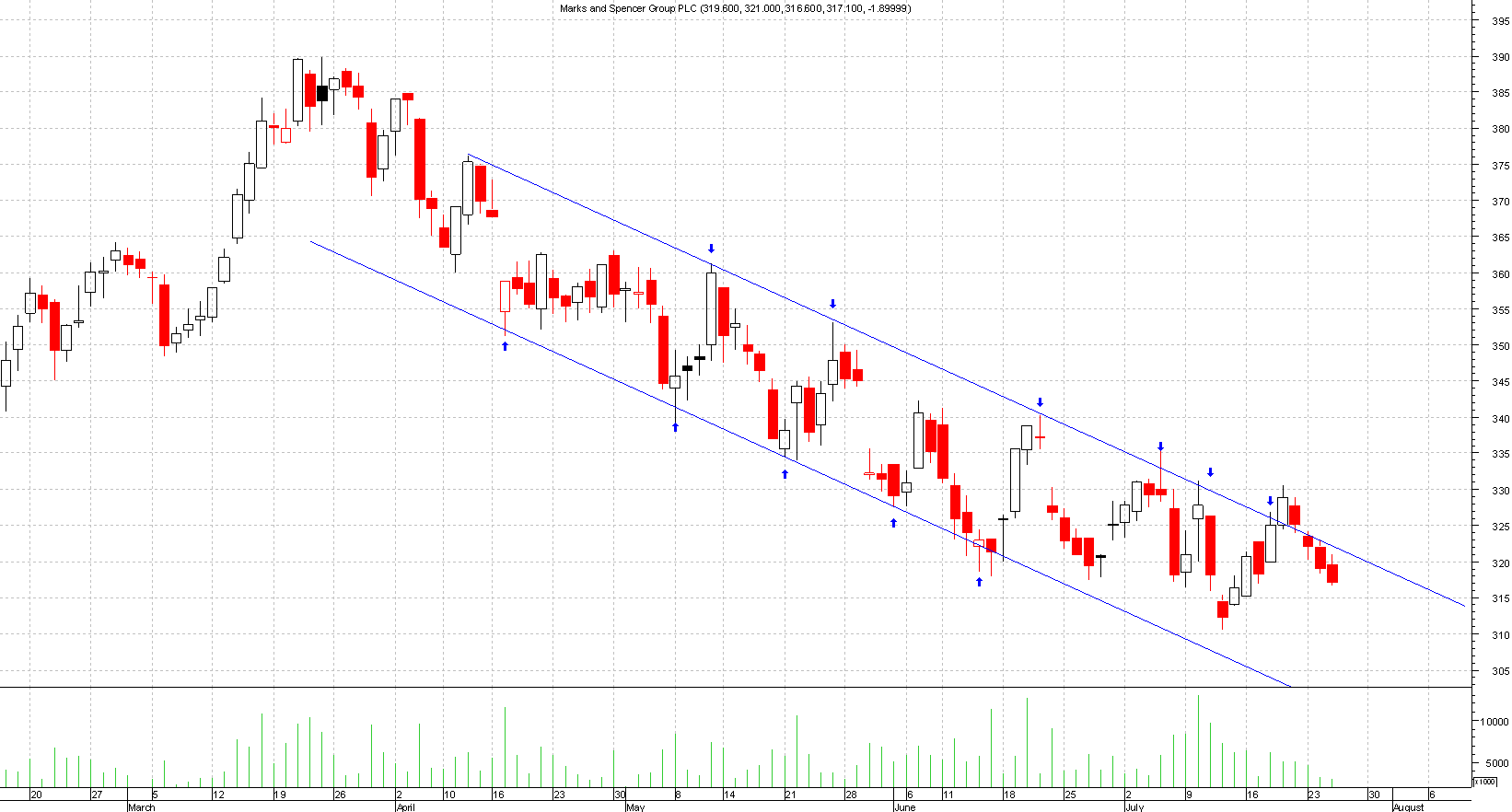
Once you have a channel line it's possible to set targets. Once a clear channel is established and a break out occurs then you can roughly guess the targets of the breakouts.
This is done by measuring the width of the channel and adding this to the breakout point.
- Details
1. Never trade on all candlestick signals. This is important as trying to trade most signals is the quickest way to lose money. Not all candlestick signals should be used to buy or sell. You should consider the risk /reward…
- Details
123 High is a method that is used to find possible tops in charts. The way this works is, that it's looking for an end to the higher highs.
- Details
This method is a very popular method and is used to find bottoms. The way it works is, that it's looking for the end to the lower lows,
so basically waiting for the first higher highs to form.
This is best used in a down trend only, the way to draw this is that you need a low point on the chart.
Then you wait for the price to move higher at which point you label it 1, then you wait for a retrace which should not go below the low.This you label 2
If it breaks below the low then you would have to start again. You still would not have an entry so you have lost nothing at this point.
If it does not go below the low but starts to move higher from here then you can label it 2. Now the buy signal comes once the price goes above the high of label 1, by doing so you have also got yourself a higher high.
Obviously this can be very confusing so best to look at the chart below for example:
Stops should be placed below label 2, the target could be the distance from top of 1 to the bottom of 2, which then can be projected from the breakout point.
So that is the level where you could take profits from but the bigger picture could be the fact that you may have found a possible bottom to the share so leave some positions on still.
You can get a few false signals and the best way around this is to use an indicator with it. The common indicator used is a Macd indicator and if this also has a buy signal then that gives the 123 low added confirmation.

Please click on the chart below for larger image

- Details
This is the trend to be going long on, this is drawn by joining the bottoms together.
- Details
You can use this on spread betting or CFD(contracts for difference)

You can use this method on index trading and currency mainly but you can use this on any form of trading. If your betting on the index to go up or down then your betting on the points.
So if your betting on the index to move higher then you would place 3 contracts to go long, which would mean:
• £3 a point trade.
• £1 for one contract.
• 3 contracts.
So once in the trade you would close 1 contract down after 20 points in your favour(or near the first resistance level near by), which ever you are comfortable with.
You then bring your stop losses to break even on the remainder of the contracts so taking all the risk off and in doing so you have got yourself a free trade as such.

Now you can set your self a limit on 1 off the 2 contracts left to close out at 50 points from original entry(or the next level of resistance).
Once this is closed out you can then adjust your stop on the last contract and let this one be your greedy trade.
The idea behind the 3 contract rule is to pay yourself to trade, most people don’t do this so hence why most traders lose.
Its a very simple system for money management and it helps in creating discipline. This will also help you take away some of the emotions out of trading.
Emotions is some thing that every new trader will experience and can be a big hindrance whilst trading. A trader that leaves emotions out of trading will stand a better chance of beating the markets
- Details
Learn to Trade
How To Trade
If you want to learn to trade and how to trade then you have come to the right place. We are continuously learning throughout our lives and here at ChartsView it is no different. If you're a seasoned trading professional, just starting out or somewhere in the middle ChartsView is here to help. Our learn to trade section is a great source of information to help you succeed in the markets.
We have tried to keep the information simple and to the point, nothing too elaborate or complicated.
Technical Analysis
We cover a wide range of technical analysis subjects included Indicators, Candlestick Charting, Trading Systems and lots more.
We also have provided a range of trading videos that not only explains but shows you how to conduct technical analysis using charting software. The charting software we use at ChartsView is: MetaStock 15.
Here at ChartsView we will regularly update the learn to trade section with more great learning material and videos for your attention so please monitor this section for updates.
